Showing posts with label University and Career. Show all posts

The 3 best things about working from home... and the 3 worst

Hey lovelies,


I took the end of last week off of work and so I also took the week off from blogging, but I am back now once again. 


As it seems that the majority of us will be continuing to work from home for the foreseeable future, I thought I would run through what I believe to be its biggest benefits, and also what I see to be its biggest disadvantages.


Here are my three favourite things about working from home, followed by my three least favourite.


Let's start with the good...


#1: An extra hour and a half in bed


I'm really not much of a morning person. When I'm working in the office, my commute is over an hour, and so I have to get up at 6:30 in order to get ready and get to work on time to start at 9. Now that my commute from my bed to my desk takes approximately half a second, I don't need to get up until 8am. 8AM! Heaven. Still too early for me though.


#2: Saving money on diesel

As I said, my commute is over an hour, and I recently upgraded from my adorable yet small Fiat 500 to an Audi TT with a much larger engine, so my fuel costs are a bit higher than initially expected. Working from home saves me a lot of money monthly, and as I physically cannot go anywhere, I have actually been able to save a lot more money than I would have otherwise!


#3: Having a bit more freedom with my working day

My work are pretty helpful anyway if you need to start late or finish early - you just work through your lunch or make sure your hours are made up another day. But working from home makes it so much easier to start early or finish late, as it means that I don't need to go anywhere. 

Working from home also means that I can do quick chores, like sticking a wash load on while I'm grabbing a coffee. They only take a few minutes, but otherwise, they would have to wait until I got home.

I can also have a bit more freedom whilst I'm actually at work. I can listen to music or a podcast without having to worry about distracting anyone, and I can eat fish for lunch without worrying about stinking out the staff kitchen haha!


As much as working from home can help, I must admit I don't really like it. Here are my 3 least favourite things about working from home...


#1: The lack of social interaction

If I have a day of no Teams meetings, sometimes I can go the whole day without verbally talking to someone until I see my family after I finish work. It is so draining and makes me feel really lonely sometimes. I miss the idle chit chat while you're waiting for the kettle to boil and the work banter that you are more likely to have in the office environment.


#2: The total lack of a work/life balance

I honestly don't know how freelancers and full-time bloggers do it. When your desk is literally half an inch away from your bed, it is almost impossible to stop thinking about work when you clock off. It's usually little things, and it is not all the time, but I can find myself thinking about work hours after I have finished for the day because there is no difference between my workspace and my relaxation space. It can be really stressful and I also sometimes panic that because I'm not working 13 hour days when I could because my desk is right there, I'm not doing enough. I would never have normally worried about this, but sometimes I do worry that everyone else is doing more than me.


#3: I actually miss my commute

Despite it meaning that I have to get up at an ungodly hour in the morning and it costs me a fortune on fuel costs, I actually really enjoy my hour-long commute. It's my me time. It wakes me up and helps to prepare my mind for the working day in the morning, and it gives my brain time to shut down before I get back home in the evening. When working from home, I feel like I miss out on this extra step so I "arrive" at work still a bit sleepy and groggy, and I "leave" still fully switched on work-mode.


Ultimately, I am just very happy and grateful that I still have a job. I do feel for everyone that has been laid off or furloughed for an extended period of time. It must be really tough. But I also know a lot of people are struggling with working from home, so I know I'm not the only one. Hopefully, we will all be able to return to work soon, whether that be getting a new job, getting off of furlough or returning to the office.


Are you guys working from home? If so, are you struggling or thriving, or somewhere in between?


With love, Chloe x

5 things I learnt at university and 5 things I've learnt since

 Hey lovelies,


This summer, it will be 2 years since I graduated from university! It's gone by fast, really fast. But it also seems like a lifetime ago. Uni really was the hardest, strangest, most challenging few years of my life, but I also had a lot of fun. And while I didn't go through university during a global pandemic, hopefully my pearls of wisdom will help some of you that are, and some that will be going through it (minus the global pandemic, fingers crossed) in the future.


Here are 5 things that I learnt during those three challenging, life-changing years.


#1: How to make friends


OK, so this one is kind of a lie because we've all been learning how to make friends since birth basically, but I feel that it's a skill that you really hone whilst at university. You are thrust into living with people that you've never met before, and you have to decide within about 3 months whether you want to live with them for the next 2 years or whether you've made better friends elsewhere. It's a fun and stressful experience, but some of these people will be in your life for a long time.

#2: How to make a meal out of anything

There will be times that your fridge is stocked, but there will also be times when you spent your weekly food budget on cheap (or not so cheap) booze. It's times like these that you discover you're the next Gordon Ramsey, if all Gordon Ramsey had to work with was half an onion, a tin of tuna, some pasta, and some frozen chicken nuggets. Seriously, some of the 'meals' I'd rustle up at uni were made out of the strangest combination of ingredients that just hadn't gone out of date yet. But you learn how to make them work and you learn how to make them yummy.


#3: How to live without your parents

Most people learn to function like a semi-normal human adult whilst at uni. You have to do your own cooking, washing up and laundry, whilst balancing your uni work and a social life. You really learn, or at least start to learn) how to get your sh*t together when you can't rely on mum or dad to do it for you.


#4: You will never - EVER - feel 100% well again

Whether it be fresher's flu, a hangover, or just the common cold, it is not long before you learn that you will constantly feel a bit unwell for the rest of your life. Mixing with huge numbers of people you've never met before is always going to be a breeding ground for germs, and that constant state of feeling 'a bit ill' never quite goes away.


#5: You are SO far away from being a grown-up

Sure, you know how to do your own laundry, but that doesn't stop you from bringing a bag of it home with you when you return for the holidays. You really start to appreciate what your parents did for you before you moved out. But it is actually those times that you are messing around and having fun with your housemates, acting like children, that you realise just how far you are from feeling like a 'grown-up'. And that's OK.


You learn a lot of things at university besides the content of your degree, but the learning doesn't stop once you graduate. Nope, every day is a school day. Here are 5 things that I have learnt since graduating in 2019.


#1: A degree does NOT equal a job

Sure, when school was selling you on applying to uni, they made it sound easy. Just go to uni to get a better job, right? Wrong. There are so many graduates that are in the same position as you. Did the same degree. Have the same (or better) grades. Unfortunately, just graduating from university doesn't guarantee you a job. But that's all part of the process. It's OK to not have your dream at your dream company lined up for a week after you graduate. You'll get there!


#2: No one really knows what they're doing

It's not the end of the world to have completed your degree and still not really know what you want to do with your life. It's good to have some direction, but as long as you're not just sat around, deliberately scavenging off of your parents for ages - you're doing fine. I used to look up to twenty-somethings when I was younger, excited for when I was an adult with it all figured out. But no one has their life that put together - especially not in their early twenties. You never know what's going to happen - if 2020 taught us anything, it's that.


#3 Sleep is much more necessary now than at university

Those days where you could pull an all-nighter writing an essay and still be up for a night out the following evening are over my friend. I don't know whether it is because of full-time work, or whether it's just the endless sleepless nights at uni finally catching up with you, but sleep, and coffee, will be your new best friends.


#4: You won't be friends with everyone forever

You know those friendships I spoke about earlier? Some of these friends will be life-long, Maid of Honour at your wedding, God Mother to your children kind of friends, and that's great. But a lot of the people that you meet at university, you'll never speak to again - or you speak once a month for the first few months and keep vowing to 'meet up for coffee' before eventually realising that it's been years since you last had a conversation. And that's OK too. Not everyone you meet at uni will be in your life forever. But the best ones will.


#5: A lot of the time, it's not what you know, it's who you know

So network, network, network! As I said earlier, there will be hundreds, if not thousands of other graduates with the same grades as you looking for a job in the same field. It's so important to get your foot in the door of your dream industry. Use LinkedIn, go to events (when they're running again), and make friends with other people in the industry. I know so many people who have managed to get an entry route into their dream career because they met the right person, or because their friends with someone who knows the right person. It could really help!


What are some things that you've learnt since leaving university? Are they similar to the lessons that you learnt whilst there?


With love, Chloe x

How to Prepare for an Interview

 Hi lovelies,


So, you've spent hours slaving over your CV, tailoring it to the specific job role, and selling yourself the best that you can. You've hit send, and now the power is in the hands of your dream company. You're not really expecting to hear anything - other than a computer-generated rejection email - but at last, the agonising wait is over and you open your inbox to find to your surprise that you've got an interview! Amazing, congratulations! But amongst the feelings of pride and success, you feel an anxiousness creep in - how do you prepare for such an important interview?!


I know the feeling. I have had many interviews over the last few years. Some have turned into job offers. Most haven't. But as a person with a full-time job, I am here to share a few tips on how to prepare for an interview.


Tip #1: Research Research Research!

Research is key! Research the company that you are interviewing for - what do they do? Who is their target audience? What are their values? Research the role - what will your daily to-do list look like? How much money should you expect to be paid? And, if you can find out who is interviewing you, research them too! What do they do at the company? Will you be reporting directly to them? LinkedIn is a great resource for this. Make sure that you know as much as possible about the company, and demonstrate this knowledge throughout the interview.


Tip #2: Prepare answers to common interview questions

As part of your research, you should look into some common interview questions. Once you've found a list, prepare some detailed answers to a few of them. Always have an example to back up your response. An easy way of doing this is through using the STAR method: Situation, Task, Action, Result. By using this method, you will easily have included some background context, an in-depth example about what you did and how you did it, and a closing statement about what you achieved through this task and what you could have done differently.


Some common interview questions that you could apply the STAR method to include: 'tell me about a time that you worked well as part of a team' and 'tell me about a situation where things didn't go to plan'. 

By having pre-planned answers to some of these questions, it will hopefully remove some of the panic and take away a few of the awkward pauses and 'ummmmm's' you do when you're manically trying to think up a response.


Tip #3: Have questions for the interviewer
Having 3 or 4 questions for the interviewer that you can ask at the end of the interview is a great way of showing off your company and role research, and will also answer some questions or concerns that your research didn't tell you. As well as this, it shows the interviewer that you have prepared well and that you're interested in the role. 

It's probably not the best time to ask about a salary - wait for them to ask, and if they don't, you'll find out if they offer you the job. Questions that you could ask the interviewer, however, include: 'what will my day-to-day responsibilities look like?' and 'what is the culture of this company?' Phrase them in a way that shows off your research. 


Tip #4: Dress to impress

Whether your interview is in person, over a video call, or just over the phone, you should make sure that your outfit matches the work environment of the company you're interviewing with. (You should have found this out through your research.) My advice is to always ere on the smarter side, even if the company has a more casual dress code. It can help you to come across as more professional and more confident. Just adding a blazer over a casual top, or wearing a pair of more structured trousers can turn a look from casual to smart casual in seconds. Even if the interviewer can't see you, the right outfit can do wonders for your mindset and confidence.


Tip #5: Have a glass of water handy

So simple, yet so important. No one wants their throat to go dry from the nerves of the interview, so having a glass or bottle of water nearby can help you to avoid the dry, cracking voice. It's also a handy prop to use when you take a bit longer to think up an answer to a question - or recall your pre-prepared response - without saying 'umm' repeatedly.


Tip #6: Relax

You've done the preparation, have a list of questions for the interviewer ready, look the part, and have water on standby. There's really not much more that you can do. So just relax - remember, they already liked you from your CV. Just sell yourself the best you can, and take the opportunity to learn more about the company and the interview process in general. The worst thing that can happen is that you don't get the role. But at least you'll have a bit more interview experience that will help you in the future!


Have any of you got any interviews coming up? If so, GOOD LUCK!


With love, Chloe x

How to cope with stress

Hello lovelies,

With it being the start of a new year, most people will be becoming inundated with social media posts boasting about how much they succeeded in 2020 despite the global pandemic and marketing materials capitalising on the 'new year, new me' trend, seemingly stating that the only way to have a 'successful' year is to completely tear down the person you were last year in order to create a new, better version this year.


Seriously, how many 'improve your productivity to improve your prosperity' posts have you seen on LinkedIn already this year? And it's only mid-January. In a society where being successful = being busy, it is becoming increasingly difficult to realise when you need to up the workload or when you need to take a step back and breathe.

According to the NHS website, 'stress is the body's reaction to feeling threatened or under pressure.' Stress can be a completely normal, manageable part of life, and can even be motivation to help us get on with tasks that we were putting off. However, too much stress can cause a negative impact on our lives, our relationships, our mental health, and our physical health.


One of the best and most important ways of coping with stress is to talk about it. With friends, family, or a professional. Talking is a really valuable way to make things feel easier. After all, a problem shared is a problem halved.

Another tip for managing stress is to split up big tasks that are stressing you out into smaller, more manageable chunks, and to plan ahead. Use diaries and to-do lists to prioritise your workload and to split up jobs. Honestly, I couldn't live without lists. I have a diary exclusively for my work, where I write daily to-do lists and check everything off once it's done. This makes me feel a lot less stressed as I have managed my workload, and I can also feel really accomplished when I have ticked everything off for that day. I also use calendars and notepads to plan the rest of my life and make to-do lists for anything that needs doing outside of my job.

Exercise is a fantastic way to relieve stress. When you exercise, your body releases endorphins. These endorphins interact with receptors in your brain and can reduce your perception of pain. They can also trigger a positive feeling in the body. For example, before lockdown 3.0, I would head to the gym if I had a stressful day, and as soon as I had completed my workout, all my angst about whatever it was that had stressed me out had completely dissipated


Getting out in the fresh air for a walk or a run - or even just sitting on a bench admiring nature - has a similar effect. Being outside can increase dopamine - the 'feel good hormone'. It's a great way to clear your head, and hey, if science says it can help you de-stress, then it must be worth a shot.

My final tip to reduce your stress is to distract yourself. Read a good book, chat to a friend, watch your favourite film or tv show - anything to take your mind off of whatever it is that is troubling you. It won't make the problem disappear, but it will definitely mask it for a while, and sometimes that is all we need.


Hopefully 2021 won't prove to be as stressful as last year was, but if you do find yourself in a bit of a frenzy, I hope that these tips will help you to feel better.

With love, Chloe x

How to write your dissertation / How I am writing my dissertation

Hello lovelies,


It has come to my attention that it has been a hot minute since I have written any university content, which is a shame because it is one of my favourite things to read about on other people's blogs. I am currently in my final year of my English and History degree and the end is near, which means the undergraduate dissertation is looming. This post is basically a few pointers on how to write your dissertation, from someone who is going through a similar thing. If you have to write a dissertation this year, you should have already started researching if not writing, but this might still be of use to you. And for students in their first and second years, this may help you too! I'll talk a bit about where I am with mine too, so if you're not at uni but are just nosy and are interested in that, I cater for you too! But I've got an inkling that this will be a loooong post, so you'll be in it for the long haul I'm afraid.

For those of you who maybe aren't British or don't know what an undergraduate dissertation is, it is basically a long essay on a subject of your choosing within your degree subject (within reason, of course). At my uni, because I do a combined degree of English Literature and History, I could either not do a dissertation and instead make up the credits with additional modules, choose to write my dissertation in either English Literature or History, or write two, one in each subject. Now, I was warned against making up the credits with additional modules, as you may think you have less work but you are actually probably writing the equivalent number of words, if not more, than a dissertation student. And I obviously wasn't going to write two LOL. So I had to choose whether to write one in English Literature or History. For me, it was an easy choice. I am better at History, and thought it would be easier to write an original take on something in History rather than Literature. This was a choice that I made waaay back in Second year. History dissertations at my uni are 10,000 words, whereas English dissertations are only 8,000, but include an earlier assignment that is basically a 2,000 word proposal form that is weighted at 20%. I knew I didn't want to do that, so History it was. So I then had to choose what to do it on. Despite not being able to write a single dissertation in English and History, I knew that I wanted to somehow combine the two fields. After speaking to my personal tutor (a tutor that we get assigned in First year that basically meets up with us once a semester and checks on our grades/ attendance/ if we need any help), again back in Second year, I decided to do a History dissertation on something to do with journalism, as it is the industry that I think I would like to go into once I graduate. At the end of Second year I made the decision that I wanted to write on British female journalists during the Second World War, and whether the war meant that there were more opportunities for women, and whether they merely assimilated with the men or wanted to change the industry. So that's what my dissertation is on. It's current working title (it will probably change another 98765456 times) is:
Women, Genre and the Second World War: Did British female journalists assimilate within the journalism trade or did they seek to change it?

Now onto some pointers about how to actually write your dissertation:

Research!
It all begins with research. Before you've even set your heart on a topic yet, you need to research, because your first idea will almost always be shaped and changed, made smaller etc. My first thought was basically the entire history of British female journalists from about the 1800s to the 2000s, including bloggers etc, but obviously that was waaaay too broad, so after researching and having help from my supervisor, I was able to narrow it down to a smaller and more niche subject. 
Once you have chosen your topic and had it approved by your supervisor, the research gets even more intense. The library, Google Scholar and Jstor will become your new best friends. Ooh and Google Books (a life saver for pretending you've read more books than you actually have - shh.) 

To get a decent grade in any humanities dissertation, but especially History, you have to use a balance of primary and secondary sources, and at Bath Spa they encourage all History dissertation students to visit archives to gain access to these. Getting access into archives is a BALL ACHE. The rules are different for every one, and some you need to apply through a form, some through email. You need copies of this form and that form, this email and your ID and student ID and basically every piece of important documentation you have ever received. Ever. OK - slight exaggeration, but it is still a lot of hard work, but worth it for me. To date, I have attended the British Library Archives in London once, and the London School of Economics Women's Library Archives in London twice. I have also been in correspondence with an archivist from New York, as while I was researching I found that an archive that would be a fantastic source of primary documents was all the way in America, and I don't have the budget for that. Thankfully though, she is sending me over scans of the documents that I would like to use, which is amazing! 

For me, I also find it easier to research as I go along so that I know the gaps in my knowledge and can fill them as I am writing, but obviously different approaches work for different people, so if you like compiling all of your research before you start, then go for it. I also feel like I have accomplished more if I have actually started writing an essay, especially one the size of this, but again - that's just me. You do you, boo. (Gross, I promise I will never say anything like that again.)

Planning!
OK, so you've started (or finished) researching. Now it is time to plan. Again, everyone writes essays differently but I urge you to write a plan for your dissertation, even if you don't usually for normal course essays. I'm not a massive fan of planning for normal essays, but I knew that because I'd be writing this piece of work over a much longer period of time, in order to keep my dissertation coherent, I'd need a plan. I found that the best way for me was to start with a small, basic skeleton plan which literally stated the chapter structure and a couple of bullet points about what I was thinking of including in them. I then built up this skeleton plan until it had more and more information on it, using my ongoing research to pad it out. I then took this plan to my dissertation supervisor for his comments.

Writing!
The best advice I can give you here is to just start writing. Even if it is utter bollocks when you first start, it is a lot easier to be productive when you're not staring at a blank word document. The first day I started, I wrote 350 words. I was super proud of this, until I strutted downstairs and announced it to my Dad, to which he sarcastically replied "well done, you've written 3.5%. Only another 96.5% to go. And that 3.5% will probably have to be reworded." Cheers for the support, Dad. But, when I looked at it again the following week, I was able to smash out a lot more work, just because there were already a few hundred words on the page. Remember, a small start is still a start, and you're one step (or in my case, 3.5%) closer to the end result. Being a humanities student, I was also advised, by numerous people including my supervisor and fitness and lifestyle vlogger @GraceFitUK (if you haven't discovered her Youtube channel go and check it out the SECOND you finish reading this blog post because she is an incredible boss of a human being that manages to smash out Oxford University standard essays and dissertations left, right and bloody centre), to leave the introduction until I am ready to write the conclusion, because my ideas haven't fully formulated yet. Which I think is fab advice, for me. But obviously this depends on your degree subject. My flatmate, Ellie, does a Psychology degree and so relies on experiments done on other people to calculate results, and so she needs to start with her introduction otherwise she'd have nothing written until probably 3 weeks before the due date (not advisable.)

Supervision!
Utilise your supervisor as much as you can! I CANNOT STRESS THIS ENOUGH! I am really lucky in the fact that, for History, there is no cap on the amount of hours you can spend chewing your supervisor's ear off. Lucky because I know that in other subjects at my uni, such as Drama and English Literature, they are capped at a certain number of hours across the whole year that they can spend with their supervisor. Which I think is silly. That is literally why they are there. To supervise. To help. To stop you crying when you (inevitably) are 3 weeks away from the deadline and are having an existential crisis and wanting to scrap your entire dissertation and change topics last minute (again, not advisable.) But I meet up with my supervisor at least once a month for a half an hour meeting, whether it be to go over ideas, a plan, a chapter, or just for some guidance. Literally, use them as much as you can. They are, probably, the only other person at the university who will end up knowing as much about your dissertation topic as you do. Mine even finds research for me sometimes. He is an ANGEL. (Love u, Cliff)

Where I'm at!
So my dissertation due date is actually the 17th of May 2019. But because I am a combined student and we are, as a uni, transferring from terms to semesters, and Easter is so blooming late this year, all deadlines and other uni dates have been moved to suit these changes. So, I actually return home from an English Literature trip to Berlin and Poland (we are visiting Auschwitz and places similar for our 'Literature and Evil' module) on the 17th of May, and so have to submit my dissertation the same day as the English Literature students, which is the 7th of May. TEN DAYS LESS TIME. I know, scary. But if I haven't finished at least writing it by 10 days before it's due, then God knows what grade I'll get. I need that time to proofread, get my friends/ family/ boyfriend to proofread, and proofread again! 

The History course at Bath Spa also set 3 smaller formative assignments (assignments that don't count) throughout the year, to make sure we are up to date. The first one was a small proposal form, that was due in October. The second, a 2,000 word 'Sources essay' (like a literature review), that was due in November. And the final one is a draft chapter, due in March. 

So far, I have written a skeleton plan, and bulked it out with research. I took it to my supervisor, who said it could make a "quite good" dissertation, but was concerned that it was too broad and would end up thinly spread. So I went away, used this information to help narrow down my plan. Having been to one archive already, I rewrote the plan, again bulked it out, and have now started writing. I haven't yet been to my supervisor, because we have had 3 weeks off for research/ reading weeks and I haven't actually returned back yet! I have now written my first chapter, and am up to 2,500 words, and visited the second archive twice. I am planning on skipping my second chapter for the time being and moving onto starting to write my final chapter this week, as I think it will be easier. I'm still not 100% sure whether more archival research needs to go into my second chapter, so that is why I will leave writing it until just before I write my introduction and conclusion. And so far, I'm kind of loving writing it. Yeah it can be a bit tedious, and trekking all the way to London 3 times (and making my dad drive me) has been annoying, but I'm loving researching and writing about a topic that I am so passionate about!

So if you are writing your undergraduate dissertation this year, or will be in the near future, I wish you the best of luck! Work hard and put the effort in, and I'm sure you'll get a grade to be proud of! My one final comment is to try and enjoy the process as much as you can! It's not often that someone can say that they are *basically* an expert in a field of their choice! So be proud! And when it's all over, you'll have a copy on your bookcase to show off to everyone that happens to venture into a near proximity of it (or at least your parents will show it off if you don't!) 

And if you're not writing your undergraduate dissertation, lucky you! Hopefully you'll be aware of the work that third years across the country (and world) go through every day in order to pass their degree! (Not bitter about all you people at all.)

Phew, that was a long one! Well done and first class honours to everyone who made it this far! Thank you so much for reading. I hope you enjoyed the post, or even found it a bit helpful!

With love, Chloe x

How I take notes at University

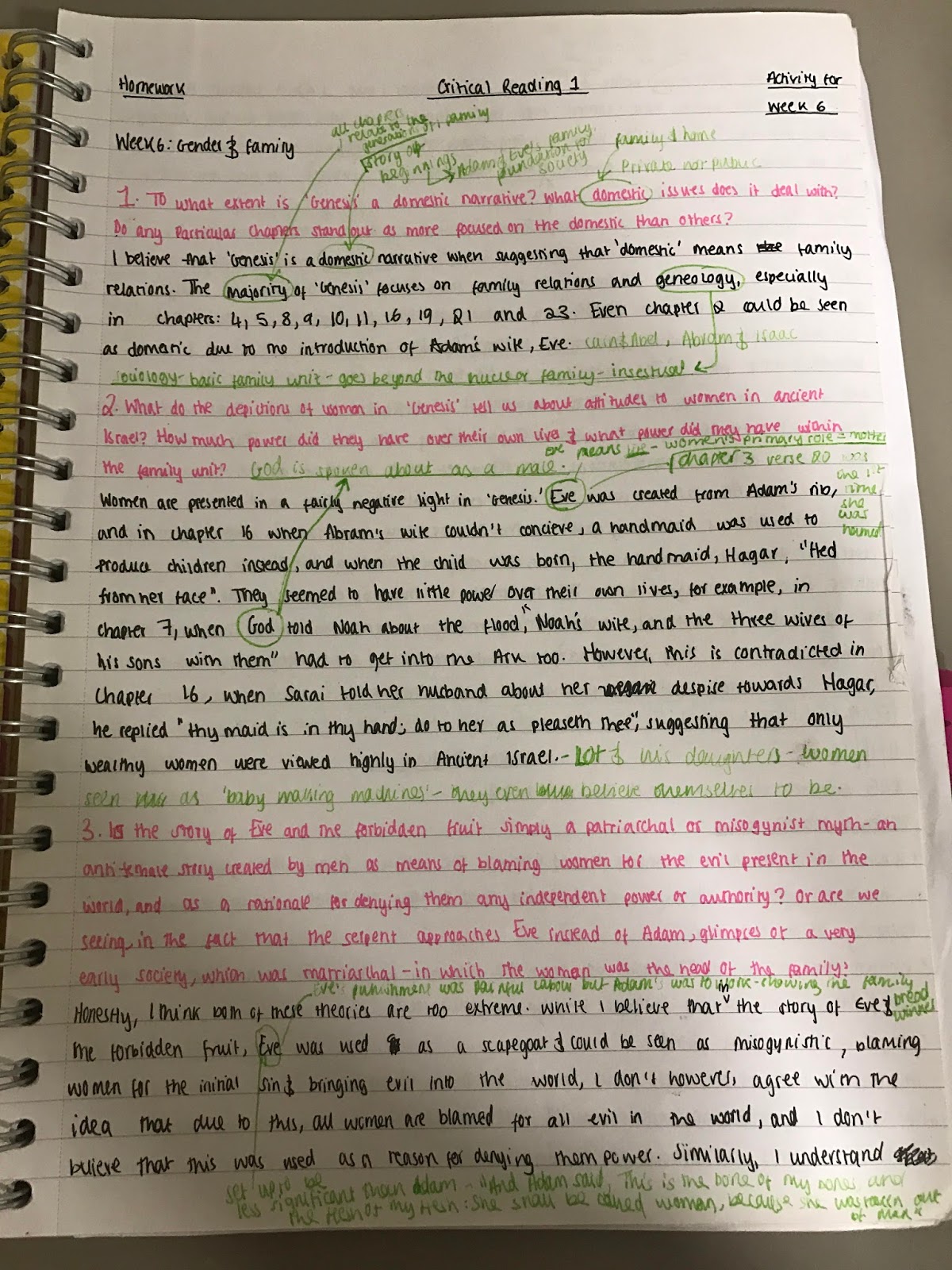
The transition between sixth form/college and university is a big one. You go from being almost spoon fed information to getting hardly any extra help unless it's asked for. You go from regular checks that you are actually doing your work (at my sixth form we did anyway) to lecturers not even chasing you if you miss a lecture or seminar, and possibly the weirdest change is that you go from hour-long lessons divided equally between teacher-led and student-based learning, to different length lectures and seminars, in both of which you are expected to do different things. For those of you at university, you probably have already mastered a note-taking technique that works for you (I'd hope), but if you will be heading to university this September, or have realised that your current university note-taking method is totally wrong for you and you need a change, this blog post will hopefully help give you some ideas of how to keep your notes organised, clear and easy to find.

First things first, I choose to take notes by hand in lectures and seminars, because I prefer having a hard copy of everything, however laptops are optional if you prefer taking notes that way. If so, though, this post probably won't help you very much. Because I already knew  I preferred taking notes by hand, before I moved to uni, my mum bought me a lot of stationary, including pens, pencils, highlighters, and most importantly, separated note books.


The ones that we bought were Pukka Pad. Because I do a combined honours degree, I bought 1 notepad for each subject that I study. These notepads are great because not only do they have a pouch to store extra pieces of paper before every new section, they have labels which you can write the title of each section in the sections tab. I use these to separate my different modules. 


As well as labelling each section, I like to begin my notes with the date, the week of the school year, the module name, and whether the notes are from a lecture or seminar.


Lectures and seminars are different types of lesson. A lecture is teacher-led, and my lecture notes are a combination of what is on the powerpoint screen and what the lecturer is saying. Some people like to print the lecture slides off before each lecture and annotate them, however a lot of my lecture slides don't get put up until after the lecture, and printing off each powerpoint would cost a lot of money that, as a student, I don't have. 

Seminars, however, are more student based and the tutor will give you a series of different tasks to do, often relating to the seminar prep that they set in advance. In my Core English module, for example, my tutor sets us around 10-15 questions to do each week. What I like to do, however this is personal preference only, is to write the questions and answers in a different colour, and when we discuss the answers in class, anything I didn't write down, I would annotate around in a third colour. This is a really useful way to distinguish between the question, my ideas, and the ideas of my peers.

When I am planning essays, especially in English, I make a simple plan outlining the different paragraphs I want to write and quotes I want to put in, separating out the plan by colour-coding each paragraph.

After making this brief plan, I like to create a more in-depth plan on plain A4 printer paper and staple it into the notebook alongside my other plan. As I am quite a visual learner, I like to draw pictures alongside my plan, to make the whole document prettier to look at.


The final thing that I am going to write about is note-taking from books. I am a book annotating kind of gal. I know loads of people hate annotating in their books as it 'ruins it' but after taking English Literature for so many years, the thought of vandalising a book with my own ideas and knowledge really doesn't bother me anymore. I like to write a brief summary of the chapter/act at the beginning, before highlighting important/interesting parts of text, and writing my thoughts about why they are important/interesting/what literary techniques they use etc. etc. 

However, when the book isn't mine, e.g a text book or library book, I like to mark the page with sticky page holders, before taking notes on a sticky note and placing it on that page. If the book has to go back before I will be done with the information, I write the author, title, publishing information and page number on each sticky note so that I can know where I quoted/paraphrased from and so not get punished for plagiarism. 


I also keep all my hand outs from lectures and seminars in ring-binders, one for each subject, with dividers inside to separate each module. (I am not going to photograph those though because boring.)

This post has been a little less exciting and more serious/advice-like than my previous posts, so feel free to let me know in the comments whether you like or dislike this type of blog post.

With love,
Chloe x

The first term of University: A whirlwind of flu, essays, cooking far too much and panicking about losing my room key

And so it begins...again.

Wow, I've come to the conclusion that I just shouldn't blog anymore because I am so shit at posting, however it is now the New Year, welcome 2017, so I shall try and start posting again. My New Year's resolution was to post weekly, but lets see how that goes. 

Last September I started university, which is a new, cool, exciting piece of information to share, so here goes. I've been at Uni for a whole term now, wow,and I go back in just under a week. I won't tell you EVERY detail of my first term as we'd be here for years, but I will (try to) share the most interesting parts of my uni experience so far, to (hopefully) make you giggle at how relatable/strange my new life is.

First thing's first, the boring stuff: what I actually study. I attend Bath Spa University and read English Literature and History. In each subject I do 1 core module and 1 optional module. I could go on to explain the different modules what I study in them but I don't want to bore you to death so I'll give that a miss (unless you are looking to study English literature or History or Combined English Literature and History at Bath Spa, in such a case leave a comment and I will discuss them with you in more detail), but, I doubt it.

Now onto the more relatable and hopefully more interesting part of my university life: my flat mates. I live on campus in a house of 10, all of which I am lucky enough to get on well with, however over the past term I have become especially close to 3 of them, Ellie, Dan and Lewis (soz to the rest of you if you're reading this, I still love you x). We have had some cracking times as a flat, and some stressful ones, from the time Ellie got so drunk that we missed the last bus and then she refused to get in a taxi and spent an hour (from 03:00-04:00) sitting on the floor in Bath city center, to our flat Christmas Day, when we cooked an entire Christmas dinner without adult supervision (I guess we are the adult supervision now!) and got suitably drunk whilst doing so, to finally getting a house of 6 to live in next year! 

Fresher's week. If there is any university advice that I can give you, it is that fresher's flu is real and to definitely take 10982092 packets of cold and flu remedies because you will need them. All of them. Other than the ever-continuing flu, my fresher's week was relatively tame. I am lucky enough (or unlucky enough, depending on how you look at it) to not be living in a house full of drunks and druggies, and to be living with people who, in my opinion, drink an acceptable amount of alcohol on a semi-regular basis. I think in fresher's week we went to 1 flat party on the first night, on which I spilt my whole double vodka and coke in some random guy's bedroom, who doesn't live in our flat (sorry James), however he did turn out to be a bit of a creep (not so sorry James), and had to change my jeans for fear of embarrassment. Other than that, we went out twice I think, once to a zoo themed night and once just out, neither of which I can remember much of, both due to my poor memory, and due to the possibly too high alcohol consumption. My flat have continued to be tame in the going out department, hardly leaving the campus, although I'm sure that will change next term. 

Now onto the hard bit. Leaving home was harder than I thought. A lot harder. Moving in day seems forever ago now, but I will never forget how much my mum cried, how my sister didn't want to leave, and how my I saw my boyfriend, Sam, cry for the very first time. Leaving my family was difficult. Leaving Sam was worse, despite only moving an hour away from home. Sam and I settled on a fortnightly agreement, either he would come up or I would go home every 2 weeks for the weekend, but that didn't really work out. I think in the entire first term, Sam and I went 1 fortnight without seeing each other, the rest of the term I saw him every weekend, oops.  

I have made some amazing friends at university and some wonderful memories that I will never forget. I have had a few emotional breakdowns over essay stress, having to cook and clean and wash up for myself (I still can't make suitable portion sizes) and living away from Sam, and despite the worry of leaving home again next week, I am really excited to return, and besides, me and Ellie have decided to start running every week in order to get fit and stay fit this year, so I have to go back, or I'll get fat. What a whirlwind of a first term, but watch out 2nd term, I'm coming for you.


With love,
Chloe x